Decoding Daniel Hawthorne: A Review of A Deadly Episode by Anthony Horowitz

Six Books In: Why A Deadly Episode is the Turning Point for Hawthorne & Horowitz
It has been nine years since the first book in Anthony Horowitz’s Hawthorne and Horowitz series, The Word Is Murder, was published, and ten years since his Susan Ryeland series began. Although my love for the Susan Ryeland series far exceeds the Hawthorne and Horowitz series we’re discussing today, its release schedule is excruciatingly slow—it’s probably not high on the publisher’s priority list (despite starting a year earlier, there are still only three books to date…).
In the beginning, the Hawthorne and Horowitz partnership was incredibly appealing to me. Even though both characters are married, their vastly different personalities, constant bantering, and the way they maintain faith and loyalty to one another despite their clashing perspectives really gave off strong bromance vibes. It was precisely that tiny glimmer of possibility that kept me chasing this series for nine whole years; my loyalty to it far outweighs my actual rating of it. This year, the sixth book in the series, A Deadly Episode, has finally hit the shelves, peeling back even more layers of Hawthorne’s past.
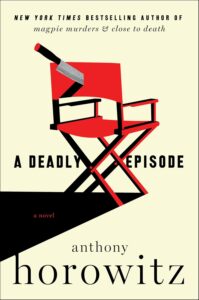
A Deadly Episode (Hawthorne & Horowitz #6)
Author: Anthony Horowitz
Genre: Meta Mystery/Whodunit
My Rating: ⭐⭐⭐⭐
The Setup: A movie-set murder that forces Hawthorne to face his own history.
The Plot: Murder on the Set of “The Word Is Murder”
Horowitz receives a notice from his agent that a production company wants to adapt The Word Is Murder into a film. However, his feelings are incredibly mixed: he’s frustrated by the screenwriter’s rewrites, unhappy with the actor chosen to play him, and dissatisfied with the overall direction of the project—not to mention his sheer annoyance upon discovering that Hawthorne’s compensation on set is several times higher than his own. Yet, he suddenly doesn’t have to worry about any of that anymore, because someone on the filming set has just been murdered!
A Deadly Episode Review: The Hits, The Misses, & Spoiler Zones
The Anatomy of an Anti-Bromance: The Bizarre Chemistry of Horowitz & Hawthorne
This series is narrated by the author, Anthony Horowitz, using himself as the main character alongside Daniel Hawthorne, a retired detective turned current consultant.
Of course, the characters in the story are fictional, but the first-person Horowitz essentially inherits the author’s actual background. While this isn’t exactly a brand-new concept, he writes it so playfully that it feels like something that could genuinely happen in real life. In particular, when DI Meadows compares him to Agatha Christie in the book, his mix of pride and grievance feels incredibly realistic! Plus, the detailed descriptions of Peter Jackson and Steven Spielberg, with Hawthorne dropping right into the mix, completely blur the final line between reality and fiction.
On the other hand, the fictional detective Hawthorne is one with sharp observational skills and excellent professional competence, but he simply does not care much about people’s feelings when it comes to work. His former colleagues describe him as a lone wolf whose unconventional methods make him unfit for the police force, though they don’t deny that he delivers results. Much like Sherlock Holmes, he can scan someone at a glance and instantly know their family situation or what they’ve been up to recently. When Horowitz asks him how he figured it out, he just stares back with innocent puppy-dog eyes and says, ‘Isn’t it obvious?’
Hawthorne has his own strict principles when it comes to his work. Although Horowitz’s role here is somewhat like Holmes’s Watson or Poirot’s Hastings, Hawthorne doesn’t want Horowitz interrupting his interrogations because it disrupts his train of thought. What he wants is someone in the background recording his success story. However, while he knows Horowitz inside out because of his observational skills and network, he is incredibly tight-lipped about his own personal life. This deeply frustrates Horowitz, who feels that even though they are partnering on a book and splitting the profits equally, they are not on equal footing. When Horowitz points out that he needs to understand Hawthorne and his reasoning better to shape the detective’s persona in the book, Hawthorne is genuinely baffled—the details of the case are all right there, so why focus so much on the detective? Horowitz explains it beautifully here:
They’re not called murder victim stories. They’re not called criminal stories. They’re called detective stories.
Compared to thrillers, the allure of a detective novel lies not just in the puzzle-solving process itself, but in how the detective’s personal traits craft the entire atmosphere of the mystery.
Because of this, Horowitz spends most of the book fluctuating rapidly between ‘I’m holding it in’ and ‘I can’t take this anymore,’ until the very end when it finally shifts into a sense of trust and reliance on his partner. Where Horowitz resembles Watson and Hastings most is that, living in the shadow of a brilliant detective, the moment he uncovers even a tiny hidden clue, he gets incredibly smug. He instantly manufactures a 10,000-word ‘truth’ in his head, planning to dazzle the master detective. Yet, just as he’s about to show off his cleverness, he invariably finds out that the detective has already examined it and has a completely different explanation.
Now, I’m not intentionally trying to ship them, but Hawthorne starts out repeatedly stepping on everyone’s toes as an aggressively straight guy. Yet, when he expresses disapproval of same-sex relationships, Horowitz speculates: ‘Perhaps he is gay himself. After all, politicians or public servants who publicly oppose homosexuality often turn out to be deeply closeted.’ Horowitz constantly brings up Hawthorne’s innocent, boyish eyes and remarks that ‘he must have been a handsome boy when he was young.’ At the climax, he even notes, ‘I am certain that Watson’s admiration for Holmes and Hastings’s affection for Poirot could not match the love I felt for Hawthorne in that moment.’ Not to mention the description in the room:
The lights were low. There were just the two of us, the chair, the bed.
And that’s that.
As it turns out, for a duo whose bickering made you think a spark of affection might blossom, their relationship only erodes further as things go on. In the end, they are a pair brought together purely by mutual benefit, bound only by a mix of financial temptation and outright coercion. Yet no matter how much these two bicker throughout the process, the ending of the stories always highlight that Horowitz has absolute faith in Hawthorne’s core integrity. This serves to passively establish the baseline of Hawthorne’s character. As a reader, even if I have zero affection for this character, I have to admit the author’s characterization remains remarkably consistent—he is so completely devoid of charm that it’s almost a marvel. Paired with a nagging, mother-hen version of Horowitz, this duo has somehow managed to carry a massive series all the way to its sixth book, likely with countless more planned for the future.
From Script to Page: The Meticulous, Atmospheric Style of Anthony Horowitz
As a reader, I hold very complex feelings toward Anthony Horowitz. He is a master storyteller. Perhaps because of his background as a screenwriter, the scenes in his mystery novels are described in meticulous detail, often hiding subtle clues crucial to solving the case. He also tends to devote substantial page space to directly portraying the characters’ inner emotions, which makes his books rather lengthy.
However, in both the Atticus Pünd/Susan Ryeland series and his Sherlock Holmes novels, there is a recurring issue: around the one-third mark, the pace begins to drag. The story meanders, making you want to yell at him to just get back to the point. It usually isn’t until the final third that everything suddenly snaps back together for a very satisfying conclusion. But with mystery novels, you can’t just skim through the boring parts for fear of accidentally missing a vital plot point or clue, which admittedly makes the middle sections a bit trying to read.
Fortunately, the Hawthorne and Horowitz series doesn’t suffer as much from this issue. Although there are moments where you get a faint sense that the author is about to let the train run off the tracks, he thankfully manages to pull it back to the main line quickly, keeping the overall pacing much brisker.